



Get in touch
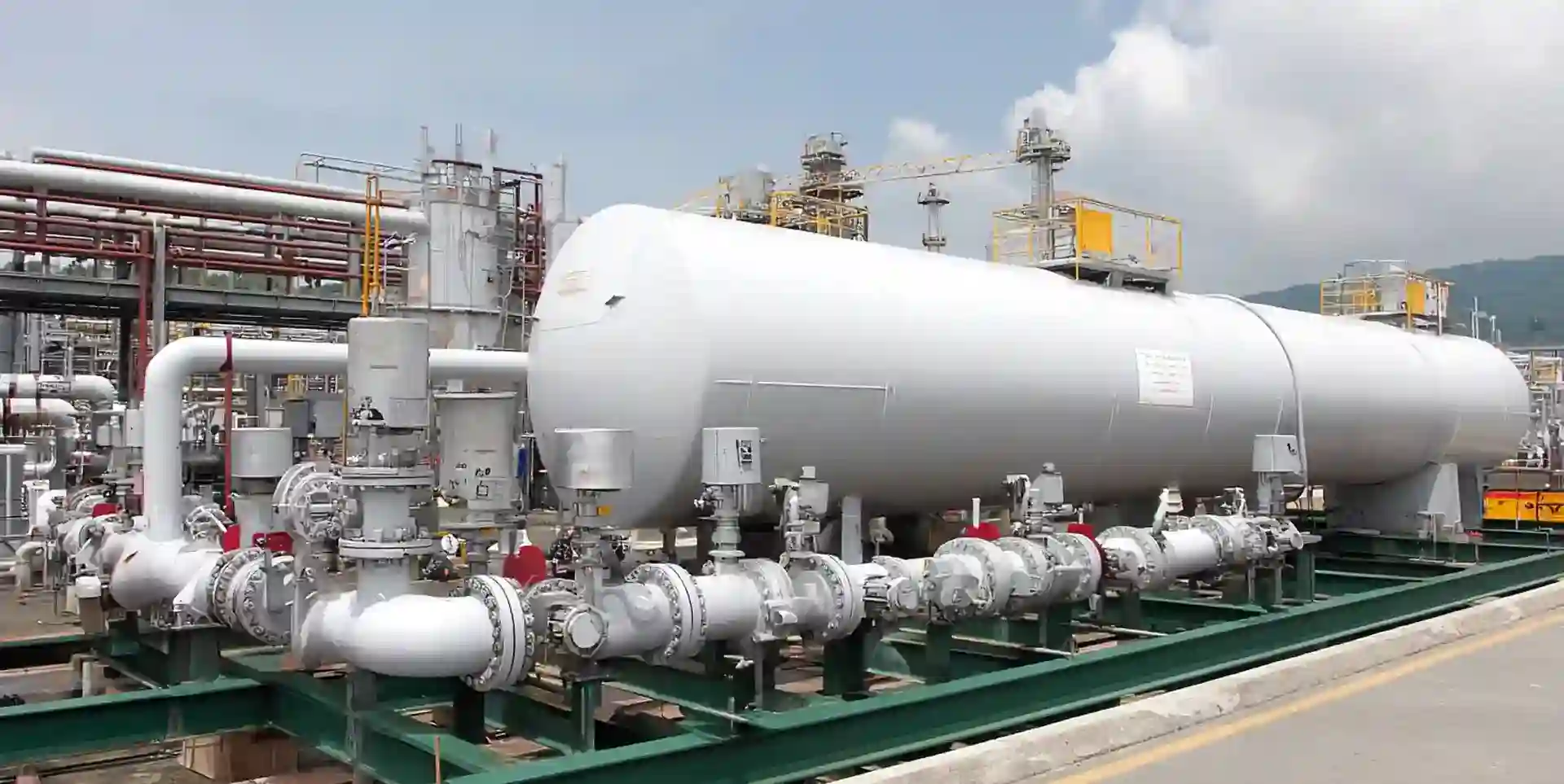
In the challenging environment of offshore energy production, industrial equipment must deliver unmatched reliability, safety, and performance under extreme conditions. The New Type of Water Jacketed Furnace for Offshore Platforms represents a significant advancement in thermal processing technology specifically engineered for offshore applications, including oil & gas processing, subsea infrastructure fabrication, and marine equipment heat treatment.
Traditional furnaces face limitations offshore due to space constraints, stringent safety regulations, and the need for efficient heat management. Our innovative water jacketed furnace addresses these challenges by integrating advanced water cooling systems with precision thermal control, resulting in highly stable operation and enhanced structural longevity.
Designed for compact offshore footprints, the furnace features a robust water jacket that surrounds the heating chamber, enabling rapid heat dissipation and uniform temperature distribution throughout the process cycle. This design not only improves energy efficiency but also significantly reduces heat stress on internal components, boosting operational uptime and reducing maintenance costs.
Comparison of Domestic and Foreign Oilfield Water Jacket Furnace Technologies
|
Name |
Domestic |
Foreign |
|
Single Unit Heat Load |
Smaller, accounting for approximately 90%. |
Larger |
|
Operating Thermal Efficiency |
70%∼80% |
85% |
|
Excess Air Coefficient |
1.3∼2.0 | 1.1 |
|
Steel Consumption |
14t/MW |
4∼7t/MW(Tubular) |
|
Load Regulation |
Manual Operation |
Automatic |
Main Technical Characteristics of Water Jacket Boilers at Home and Abroad

1) Enhanced combustion
2) Increased heat intensity of the fire tube
3) Proper control of excess air coefficient in combustion
4) Used in conjunction with small smoke tubes to enhance heat transfer
1) The heat pipe has high thermal conductivity.
2) Lateral scouring enhances heat transfer on the flue gas side.
3) There are many weld points, and effective flaw detection is impossible.
1) Furnace heat load control
2) Excess air coefficient control
3) Automatic burner control
1) Steam heat exchange with coils
2) The heat transfer temperature difference has been improved.

1) The thermal efficiency of the water jacket boiler reaches approximately 90%.
2) The steel consumption of the water jacket furnace is less than or equal to 6 t/MW;
3) Combustion noise is below 80 decibels.
Enhanced Heat Transfer Principle
Enhanced heat transfer is achieved by promoting fluid turbulence. During fluid flow, the presence of three-dimensional ribs causes acceleration between the ribs, and the direction of this acceleration is parallel to the thermal boundary layer, which can directly thin the thermal boundary layer. The flow of fluid around the three-dimensional ribs will form a Karman vortex street behind the ribs, thereby promoting heat transfer.
Miniaturization and high efficiency
Reduce metal consumption
Optimize the heating structure and improve the efficiency of the heating furnace.
Improve furnace structure and overall configuration to enhance space utilization.
Reduce pressure level, improve safety, and reduce metal consumption.
Simplify manufacturing process
1) The length of the flue tube structure is reduced by approximately 50%, and the width by approximately 40%.
2) The tube diameter is reduced by 21.4%, and the tube length is reduced by approximately half.
3) The design pressure is reduced from 0.4 MPa to 0.1 MPa.
4) The heat exchange area of the coil per unit volume is increased, and the design resistance is halved.
5) The design thermal efficiency is increased from 83% to 90%.
6) The steel consumption of the water-jacketed furnace is reduced to 6 t/MW, a reduction of approximately 50%.
Application of Marine Platforms
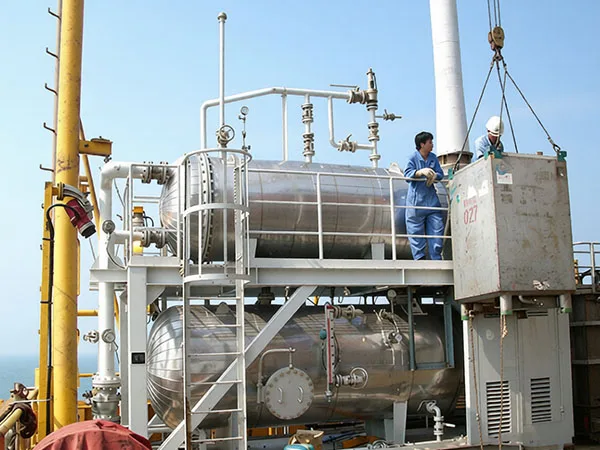
In 2007, it was applied to the WZ6-1, WZ11-1, and WZ11-4N platforms in the Weizhou Oilfield. Five years of use have shown that the new type of water jacket furnace for offshore platforms can meet the requirements of the marine environment, has good safety and corrosion resistance, and ensures that the temperature of the heated oil meets the process requirements.

For offshore platform equipment, safety is the primary concern, requiring consideration of marine equipment standards. Because the vacuum high-efficiency water jacket furnace operates under negative or slightly positive pressure (rated operating pressure: vacuum phase change – 0.0 MPa; slightly positive pressure phase change – 0.04~0.061 MPa), its operational safety is very high. In terms of automatic control, it is equipped with safety interlock automatic control systems for furnace over-temperature, over-pressure, burner flameout, and fuel leakage, meeting the requirements for unattended operation.
Because the high levels of chloride ions (Cl-) in marine crude oil or seawater have a strong corrosive effect on carbon steel pipelines, the crude oil heating coils of offshore platform-specific water jacket furnaces are made of chloride-resistant materials to address this issue. Furthermore, a special insulation protection design is incorporated into the structure of the crude oil heating coils, blocking the electrical circuit for electrochemical corrosion and protecting the heat exchanger. Even when heating pure seawater, chloride ion corrosion will not occur.
The intermediate heat medium is heated and evaporated, then exchanges heat with the crude oil heat exchanger tube bundle. The released latent heat of vaporization is transferred to the heated crude oil through the tube bundle. Since each unit mass of gaseous heat medium can store 80 times more heat than liquid heat medium, its heat transfer intensity per unit mass is much greater than that of traditional water-immersed crude oil heat exchanger tube bundles. The vacuum or low-pressure high-efficiency water-jacketed furnace is designed with an exhaust gas temperature ≤170℃. Its thermal efficiency is ≥90%, more than four times higher than the current "thermoelectric-electric heating" method for offshore platforms, and the initial equipment investment is significantly lower than that of the "thermoelectric-electric heating" method, resulting in significant economic benefits. Due to its high efficiency, energy saving, and compact layout, the equipment's footprint and weight are greatly reduced, reaching 6T/MW, which is superior to the 10T/MW level of land-based water-jacketed furnaces, making it particularly suitable for the special requirements of offshore platforms.
The specially designed high-efficiency water jacket furnace features safety, reliability, energy efficiency, resistance to seawater chloride ion corrosion, intelligent control, light weight, and small footprint, offering excellent cost-effectiveness. Compared to the "gas-fired power generation-electric heater" method, it not only achieves gentle heating of the oil transport medium but also overcomes the problems of carbon and scale buildup on the heating rods. Its operating thermal efficiency is more than four times higher than that of electric heating solutions, resulting in significant economic benefits. Therefore, the high-efficiency water jacket furnace for offshore platforms can completely replace existing crude oil electric heaters in offshore oilfields for crude oil heating applications, demonstrating a very broad application prospect.

Zhengyuan Petrochemical
Create the greatest value for customers
Provide the best quality products and services
+8615896509239
Jeffrey@petrochemicalzy.com
No. 8, Xinxin Road, Luoxin Industrial Park, Xin'an County, Luoyang, China
 WhatsApp