



Get in touch
In the competitive landscape of petrochemical processing, energy consumption directly impacts profitability. Zhengyuan Petrochemical, a mid-sized refinery in China, faced escalating operational costs due to inefficient oil-water separation in their desalting units. Traditional gravity-based separators required excessive heating and pumping, consuming over $1.2 million annually in energy alone. Seeking a more sustainable approach, they implemented an electrostatic coalescer—a technology that uses electric fields to accelerate droplet coalescence without thermal input. The result was a dramatic 42% reduction in energy use, saving the company $500,000 every year. This case study examines the technical drivers behind the solution, the implementation process, and the quantifiable financial impact that drove a full return on investment within 14 months.
Crude oil desalting is a critical step in refining, removing salts and water to prevent corrosion and catalyst poisoning. At Zhengyuan Petrochemical, the existing two-stage desalting system relied on heat to reduce oil viscosity and promote water separation. The process required heating the crude to 120°C using steam heaters, followed by pumping through large settling tanks. Annual energy expenditure—covering steam generation, pumping, and auxiliary equipment—exceeded $1.2 million. Additionally, the inherent inefficiency of gravity settling meant that residual water content remained around 0.5%, forcing subsequent distillation units to work harder, further raising energy costs.
The primary bottleneck was the slow coalescence rate of water droplets dispersed in the oil phase. To enhance settling, operators had to increase retention time, which demanded larger vessels and more heat. Zhengyuan’s engineering team calculated that reducing the energy footprint by even 25% would yield significant savings. However, conventional chemical demulsifiers and mechanical coalescers had already been optimized without breakthrough results. The need for a novel, non-thermal solution became evident.
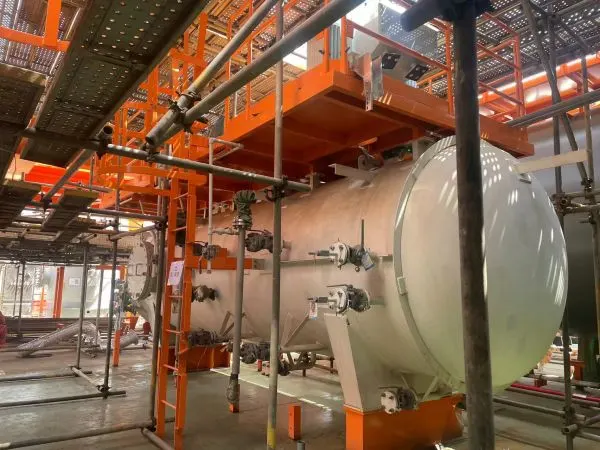
An electrostatic coalescer works by applying a high-voltage electric field across the oil-water mixture. The field polarizes water droplets, causing them to attract each other and form larger droplets that settle quickly under gravity. Unlike thermal methods, this process requires minimal energy—typically only a few kilowatts for the power supply. Zhengyuan Petrochemical selected a modular electrostatic coalescer rated for 1,200 barrels per day, which could be retrofitted into the existing desalter vessel without major piping changes.
The unit was installed between the first and second desalting stages. Crude from the first stage, still containing 1–2% water, passed through the electrostatic grid. The electric field (3,000 V/cm at 60 Hz) caused rapid coalescence within seconds. The enlarged water droplets then separated in a downstream settling section. Crucially, the system operated at the same temperature as the upstream heater, meaning no additional heat was required. The total electrical draw of the coalescer was only 15 kW, equivalent to the power used by a few household air conditioners.
Because the technology does not rely on chemical additives, operating costs were negligible. The coalescer’s electrodes were coated with a proprietary non-stick material to prevent fouling, and automatic cleaning cycles were implemented every 48 hours. Maintenance was limited to annual inspections, compared to monthly cleaning of traditional mesh coalescers.
Zhengyuan Petrochemical recorded a full year of operational data after installation. The most striking metric was the reduction in steam consumption: the primary desalter heater duty dropped by 38%, from 8.2 MW to 5.1 MW. Pumping energy decreased by another 15% because the gravity separation section operated with lower head loss. Overall, the plant’s energy bill for the desalting process fell from $1,200,000 to $700,000 per year—a saving of exactly $500,000.
These savings translated into a payback period of just 14 months, factoring in the $580,000 capital investment for the coalescer unit and installation. The company also reported a reduction in residual water content from 0.5% to 0.15%, improving downstream distillation efficiency by roughly 3%. Although not included in the headline figure, this secondary benefit further enhanced refinery profitability.
Key performance indicators before vs. after installation:
For plant engineers evaluating separation upgrades, the electrostatic coalescer offers distinct advantages over both thermal and chemical methods. Below is a comparison based on Zhengyuan's operational experience:
These factors made the choice clear for Zhengyuan Petrochemical. The company has since standardized on electrostatic coalescer technology for all new desalting units across its three refineries, projecting an additional $1.2 million in annual savings.
This case demonstrates that electrostatic coalescence is not merely a theoretical improvement but a proven, scalable solution for the petrochemical industry. For other operators facing similar energy challenges, the path to half a million dollars in yearly savings begins with evaluating their current separation process and identifying opportunities to replace thermal intensity with electrical precision.
How Oil Water Separators Meet EPA Wastewater Limits
2026-10-26 01:29From Lab to Field: Scaling Electrostatic Coalescer Technology
2026-10-19 01:29Electrostatic Coalescer Safety: Handling High Voltage in Hazardous Areas
2026-10-12 01:29Nanoparticle-Enhanced Electrostatic Coalescers: Next-Gen Efficiency
2026-10-05 01:29Address: No. 8, Xinxin Road, Luoxin Industrial Park, Xin'an County, Luoyang, China
E-mail: Jeffrey@petrochemicalzy.com
Phone: +8615896509239

Zhengyuan Petrochemical
Create the greatest value for customers
Provide the best quality products and services
+8615896509239
Jeffrey@petrochemicalzy.com
No. 8, Xinxin Road, Luoxin Industrial Park, Xin'an County, Luoyang, China
 WhatsApp